Why the hardest part of eating alone lasts less than five minutes — and what waits on the other side.
There’s a particular kind of hesitation I want to name.
You’re walking down a street. You pass a restaurant. Warm light spilling out of the windows, low murmur of conversation, the smell of something excellent drifting through the door. You slow down. You glance in. And then — because you’re alone, because it’s a Tuesday evening, because what would it look like — you keep walking.
Maybe you’d have loved that meal. Maybe it would have been the best hour of your week. But the small friction of walking into a restaurant by yourself, of asking for a table for one, of navigating the couple of minutes between sitting down and settling in — that friction won. You went home. You reheated something.
I’ve done this. Many times. Most solos have.
And here’s what I’ve learned, after enough Tuesday evenings walked past enough warm windows: the friction isn’t the meal. The friction is roughly four minutes long. And on the other side of those four minutes is a much bigger life.
Let’s talk about how to get through them.
What the Four Minutes Actually Are
Solo dining feels awkward for a specific, timeable stretch — and it helps to know what you’re actually dealing with.
Minute One: The walk-in. Approaching the door with the small, private awareness that you’re about to ask for a table for one. The mental rehearsal of the sentence.
Minute Two: The host stand. Saying the words. Watching the host process the request. The brief, imaginary pause where you assume they’re judging you (they’re not — they’re calculating table math).
Minute Three: Being walked to your seat. The short journey across the room where you assume the whole restaurant is looking up (they’re not — see below).
Minute Four: Sitting down. Opening the menu. Deciding what to do with your hands, your eyes, your posture. Setting up your small territory at the table.
That’s it. Four minutes. Somewhere around minute five — when the water arrives, or you’ve picked a dish, or you’ve opened your book — the discomfort quietly evaporates and you’re just… a person having a meal.
The four minutes are real. But they are finite. And knowing they’re finite is half the battle.
The other half is design.
Three Rules That Make the Four Minutes Easier
Rule One: Skip the Host Stand. Head to the Bar.
The host-stand-for-one moment is where about 80% of the awkwardness lives. It’s the moment you have to announce your soloness to a stranger, watch them nod, and be escorted across a room to a two-top with one empty chair opposite you.
Skip the entire ritual.
Walk into the restaurant, look for the bar or counter seating, and go straight there. Most restaurants have counters designed exactly for this — the bar itself, chef’s counters facing the open kitchen, communal high-tops near the window. You are not asking for a favor. You are using the seat the restaurant literally built for solo diners.
The bar is the solo diner’s happy place for a few reasons:
- It’s socially expected. Nobody sits at a bar and gets side-eyed for being alone. It’s the bar’s entire function.
- The bartender is company without being an obligation. They chat if you want to chat, disappear if you don’t. It’s the exact right dose of human presence.
- You can see the room without being seen. Bar seats usually face the room or the kitchen, not other diners. Nobody is looking at you because they’re facing the other way.
- The service is faster. Bar service is quick. If you’re feeling nervous, this shortens the total time between arrival and food, which shortens the total time you spend feeling unmoored.
For your first few solo meals, always choose bar or counter seating if it exists. Save the sit-down two-top for later, when the muscle has developed.
Rule Two: Give Your Hands a Job. (Not the Phone.)
The second scariest part of solo dining is the between-food gap. You’ve ordered. Now you’re waiting. Ten minutes. Fifteen. What do you do?
Most solos default to the phone. This is a mistake.
The phone is a trap for several reasons. It signals “I’m here reluctantly and would rather be anywhere else” — which isn’t true, but it reads that way. It sucks you out of the room, so you miss the ambient pleasures — the light, the music, the smells from the kitchen, the small dramas at other tables — which are, honestly, half the reason to eat out at all. And it becomes a compulsion: once you’re on the phone, you’ll be on the phone for the whole meal, and you might as well have eaten at home.
Instead, bring something you can hold with your hands and your attention.
A book is the classic choice, and there’s a reason — a book is portable, socially legible, absorbing, and signals “I’m here on purpose.” A journal works if you want to think about your day. A magazine or a stack of New Yorker back issues if you want lighter fare. A crossword or a small sketchbook if you want something more tactile.
The idea isn’t to disappear into your book — it’s to have somewhere to look between courses. Something to touch when you feel unmoored. An anchor. A small analog object that says I belong at this table.
The book is also, incidentally, the number one conversation-starter with the bartender or a neighboring solo. If you don’t want the conversation, keep the book open. If you do, close it briefly and glance up. Signaling with objects is a lost art. Solos should reclaim it.
Rule Three: The Spotlight Isn’t On.
Here’s the psychological trick that actually, measurably works — and it comes with research to back it up.
Psychologists have a term for what makes solo dining feel so exposed: the spotlight effect. It’s the well-documented tendency of humans to wildly overestimate how much other people are noticing them. In one famous 2000 study by Thomas Gilovich, participants wore an embarrassing T-shirt into a room and were then asked how many people noticed. They guessed roughly half the room. The actual number was about a quarter — and even that overstates it, because “noticed” was defined as merely seeing, not judging or remembering.
The takeaway: we walk around convinced that everyone is watching us, when in fact almost everyone is deeply absorbed in their own moment.
Apply this to the restaurant:
- The couple two tables over? Worried about their own conversation. They haven’t looked at you.
- The group in the corner? Deep in their group dynamics. They haven’t looked at you.
- The server? Thinking about table 7’s order and how long the kitchen is taking.
- The bartender? Mixing drinks and half-listening to a regular.
- The other solo person at the bar? Also worried about looking awkward and grateful you exist as evidence that they’re not the only one.
Nobody is running a running commentary on the solo diner. You are a background character in every other person’s movie, exactly as they are a background character in yours. That’s not a lonely truth. That’s a liberating one.
Sit up. Order what you want. Take your time. Let yourself have the meal.
The spotlight was never on.
What Waits on the Other Side of the Four Minutes
Here’s the thing nobody tells you about solo dining until you’ve done it a few times:
It’s genuinely lovely.
Not “lovely for a solo person.” Not “as good as dining with a friend.” Just lovely, full stop, in ways that dining with company sometimes isn’t.
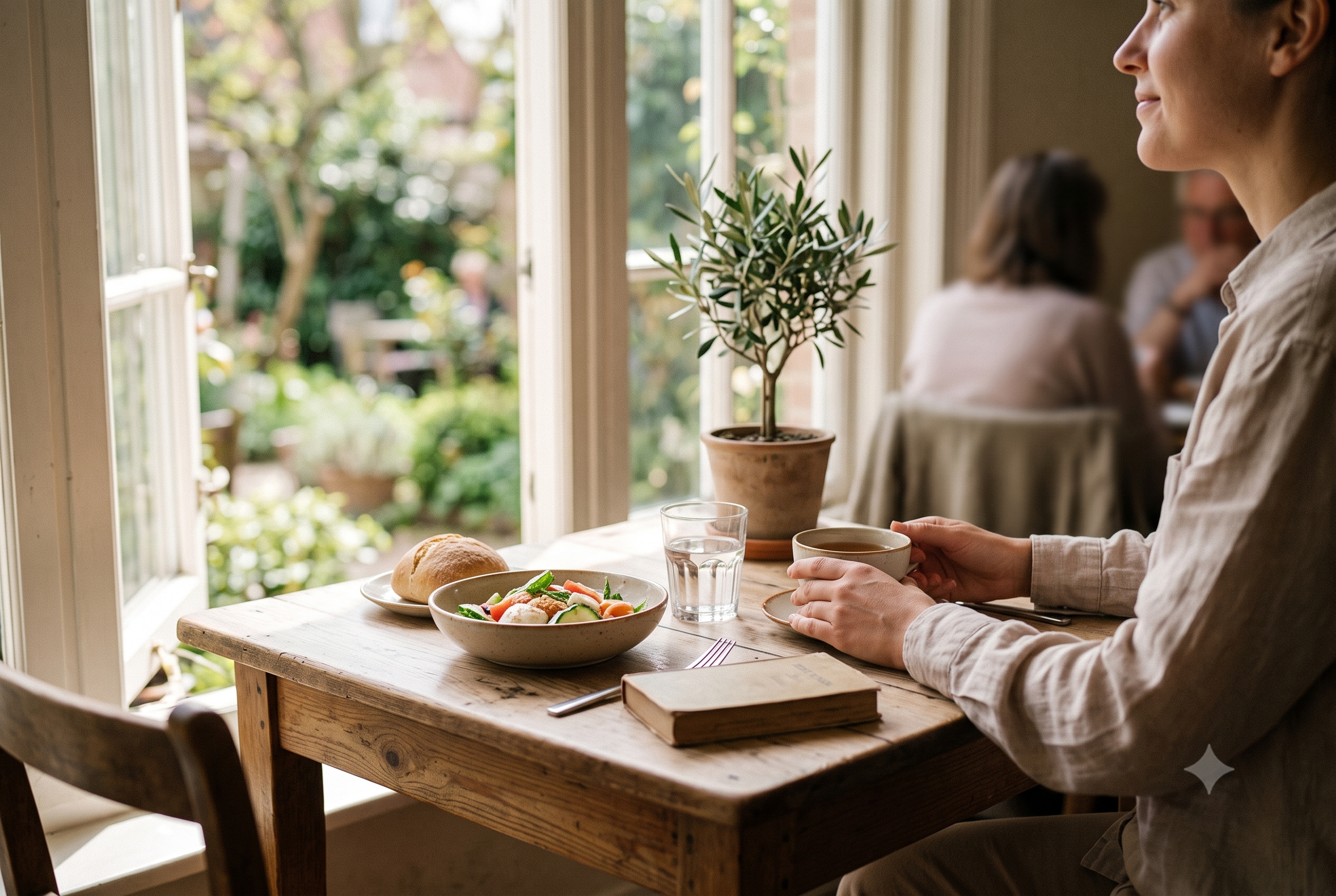
When you eat alone, you taste the food. There’s no conversation to split your attention. The first bite of the pasta gets your full concentration. The wine gets savored. You notice the herbs, the acid, the texture. Many solos discover, embarrassingly late, that they actually love eating — they’ve just been doing it as a social activity for so long that the food itself was background noise.
When you eat alone, you choose your own adventure. No compromising on the restaurant. No negotiating what to share. No waiting for the slower eater. If you want three appetizers instead of a main, order three appetizers. If you want to stay for an extra glass of wine and read a chapter, stay. If you want to leave after 40 minutes, leave. The whole meal is calibrated exactly to you.
When you eat alone, you watch the world. The best people-watching happens when you have no company to distract you. The couple on their third date, the family celebrating something, the two old friends who haven’t seen each other in years — these are small novels playing out at every table. You get to read them.
And when you leave — walk out into the evening air, digest, wander home — you notice something quiet has shifted. You had an entire experience by yourself. No permission needed. No coordination required. Just you, walking into a place, sitting down, being served, tasting something excellent, leaving.
That’s a small permanent expansion of the world you can access.
The Assignment
Pick one place. Something small — a café, a wine bar, a noodle counter, that bakery-with-lunch-service you’ve walked past twice already this month. Not the fancy tasting menu. Not the intimidating three-star. Something warm and low-stakes.
Go on a weekday evening or a Saturday afternoon — moderately busy, not empty, not slammed. Bring a book you’re actually enjoying (the physical kind, no e-readers if you can help it).
Walk in. Skip the host stand. Head straight for the counter or the bar. Order something you actually want. Set your book on the counter. Look around. Notice the light. Notice the music. Notice what the kitchen smells like.
For roughly four minutes, you may feel a little exposed. That’s the tax. It’s finite. Pay it.
Then — and this is the moment I want you to catch — somewhere around minute five, you’ll feel the discomfort quietly leave. You’ll take a sip of your drink. Open the book. And realize: this is nice. This is really nice, actually.
That’s the moment.
Once you’ve had it once, you have it forever. You’ll walk past warm restaurant windows differently for the rest of your life.
The four minutes were the whole assignment.
The rest is yours. 🤍