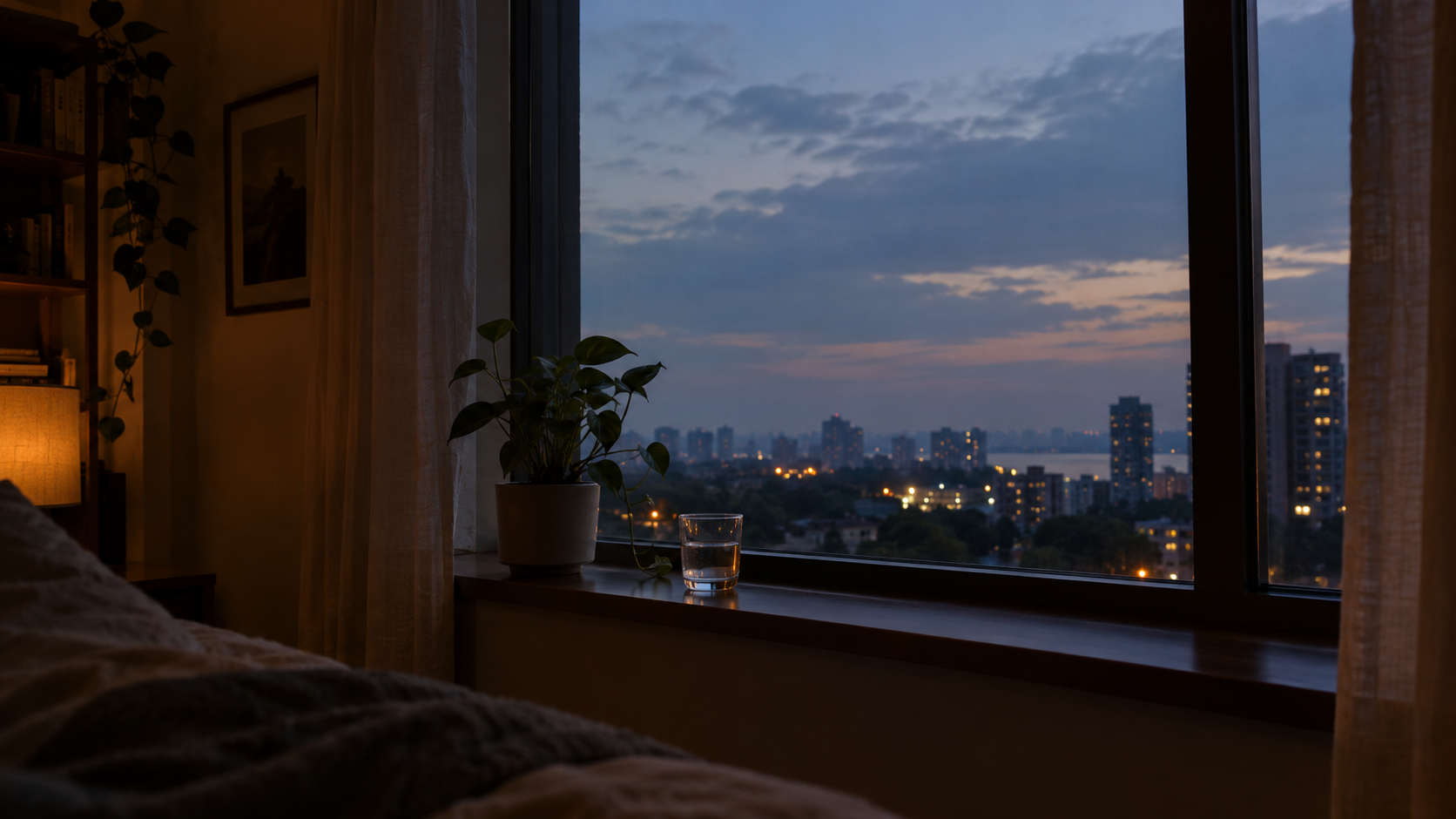
On solo caregiving, anticipatory grief, and the strange paradox of a quiet room that is both the burden and the balm.


There is a specific kind of weight that nobody writes about, and it is carried, right now, by more people than any of us realise.
It is the weight of being a solo caregiver.
Not the parent-of-many juggling kids and an ageing parent. Not the married daughter whose spouse quietly absorbs half the emotional load. The solo caregiver. The one who holds a parent’s slow medical crisis from a one-bedroom apartment. The one who comes home from the hospital at 9 pm to a quiet that is both her refuge and her burden. The one who, when the day’s medical performance ends, has no one in the room to turn to and say “it was hard today.”
Solo caregivers are, demographically, a growing category — ageing parents, delayed partnership, geographic distance from siblings, chosen singlehood. And yet almost nothing is written for them. Caregiver burnout literature assumes a partnered caregiver. Solo living literature assumes a person with no major caregiving obligations. The intersection — the solo person holding a loved one’s slow medical reality — is one of the most invisible labors in contemporary life.
This essay is for that intersection.
The Weight Does Not Live in the Hospital
Here is the first thing to name clearly.
During the hospital day, the caregiver is working. Reading scans. Asking doctors the next question. Holding a parent’s hand through a procedure. Coordinating with family. Calling the pharmacy. Noting side effects. Managing logistics. Performing competence.
There is no room for the full weight of what is happening, because there is a day to get through. Hospital hours have structure. The structure protects you.
Then the day ends.
You leave the hospital. You get into a cab. You climb the stairs. You turn the key in the lock.
And the quiet of the apartment is suddenly, enormously loud with everything you were holding at bay for the previous twelve hours.
This is where the real weight of solo caregiving lives. Not in the beeping machines. Not in the specialist appointments. Not even in the hard conversations with doctors. In the apartment, at 9 pm, after everyone else has gone home to their partner or their family or their roommates — and the solo caregiver is alone with the full emotional weather of a day she spent being capable.
For partnered caregivers, there is a buffer. A spouse who registers the silence over dinner. A hand on the shoulder. A voice that says “it was a hard day, wasn’t it.” Even a mild, imperfect buffer absorbs some of the delayed-impact weight of the hospital day. The weight is still there, but it has somewhere to go.
For solo caregivers, there is no buffer. The weight that was held at bay by the day’s structure now has nowhere to go but into them, in the exact room where they are also expected to sleep, eat, recover, and get up for the next hospital day in nine hours.
The empty apartment holds what the apartment was never built to hold.
Anticipatory Grief Is a Real Thing
The medical term for what many caregivers feel in the long middle of a loved one’s illness has a name, and most people do not know it until they are inside it. Anticipatory grief. The grief that arrives before the loss. The mourning of someone who is still here, but whose future absence has become visible on the horizon.
It is one of the strangest emotional weather systems a human nervous system can navigate. The caregiver is mourning someone while still being with them. In the same hour, laughing with a parent about a nurse’s joke and crying in a bathroom stall because the next six months have become suddenly visible. The two feelings do not take turns. They happen simultaneously. The caregiver gets used to being, somehow, both grateful and bereaved in the same breath.
Palliative care literature describes anticipatory grief as particularly disorienting because it has no clear object. You cannot fully mourn a person who is still asking you about lunch. You cannot cry for a loss that has not happened. And yet the grief is there, real and heavy, following you from the oncology ward to the parking lot to the car to the apartment.
For solo caregivers specifically, anticipatory grief has a quality that nobody names: it accumulates in the empty home. Partnered caregivers can distribute some of this grief across the household — the partner is grieving too, the shared evenings metabolise part of it, the joint future is being re-shaped together. Solo caregivers hold the full weight of the anticipation alone.
They go to bed with it. They wake up with it. They eat breakfast with it. They carry it to the hospital, where it quietly steps aside while they perform. And then they bring it home with them, every night.
If you are feeling something strange and unnamed — if you are feeling it in an empty apartment after days of being capable at hospitals — know this: the feeling has a name. It is a known pattern. You are not inventing it. You are not weak for feeling it. It is one of the hardest emotional labors a human is asked to perform, and it is the specific labor of solo caregiving.
The Paradox Nobody Writes About
Here is the part the discourse misses, and the part that is most worth naming.
The empty apartment that holds the weight is also, strangely, the place where solo caregivers regulate.
The caregiver comes home. Takes off the day. Showers off the hospital. Sits on the couch with a cup of tea. The silence is heavy — yes, it is heavy — but it is also the only place where the day’s accumulated static can finally fall off. In a partnered home, she would be performing one more small conversational register before she could truly land. In the empty apartment, she lands immediately. The silence is a landing strip.
Partnered caregivers have a different problem: they must titrate their emotional output across the evening because another person is in the room. They cannot fully collapse. They must still be a spouse, a parent, a roommate, after being a caregiver all day. The emotional load of the hospital gets extended by the evening’s social performance, even a loving and gentle one.
Solo caregivers get to collapse. Fully. The moment the door shuts behind them.
And this is the paradox the literature does not capture. The empty apartment is both the thing that makes the weight unbearable and the thing that makes the recovery possible. It is where the day lands too hard. It is also where the nervous system catches up. It is where the caregiver becomes, quietly, the person who can show up at the hospital again tomorrow.
The silence is both the cost and the ground.
Many solo caregivers, if asked honestly, would not trade it. On the nights when the oncology ward’s reality has broken through their competence and they have arrived home barely holding — the thing that saves them, again and again, is the apartment itself. The quiet. The familiar objects. The specific light. The ritual of making tea in their own kitchen. The non-performance of simply being, without having to be for anyone.
For many solo caregivers, the apartment becomes the only reliable regulation tool during a long caregiving arc. And it does the job.
What Solo Caregivers Deserve to Know
A few things, briefly, that this intersection rarely gets told.
The exhaustion is real, and it is specifically shaped. It is not the exhaustion of a hard work week. It is not the exhaustion of a bad personal patch. It is a compound exhaustion that stacks the physical labor of hospital days, the emotional labor of anticipatory grief, and the solo labor of regulating alone — all on the same body, every day, for months. Anyone carrying this load should know: it is heavy because it is heavy, not because you are weak for feeling it.
The empty home is not failure. It is infrastructure. The silence is doing something for you that no partner could, even a loving one. Honor it. Do not fill it reflexively with television, podcasts, or constant background noise. Some of the quiet is the medicine.
Anticipatory grief is a known category with trained specialists. Grief counselors who specifically work with pre-loss grief exist. They are a real resource. They will not interrogate your life, your choices, or your caregiving decisions. They will simply help you hold what you are already holding. For solo caregivers especially — who do not have a partner’s ear in the evenings — this kind of professional support can be the difference between carrying the weight well and carrying it brutally. In India, iCall (9152987821) and the Vandrevala Foundation (1860-2662-345) both have counselors trained for this.
The person being cared for is often, remarkably, the lightest person in the room. Patients navigating serious illness frequently display a kind of quiet grace that undoes everyone around them. If you are the caregiver and you are more undone than the patient, that is not inversion — that is the specific weight of being the one who has to keep functioning while loving someone who is slowly leaving. The patient has their own labor. Yours is different and it is also real.
You do not have to perform recovery between hospital days. The evening is not a space to “bounce back.” It is a space to rest in the heaviness, so that tomorrow’s capacity can rebuild from a place of truth rather than performance. The empty apartment is where this real rest happens.
A Closing Thought
If this essay reaches someone currently in that intersection — someone who spent today at a hospital with a parent, who came home to a quiet apartment at 9 pm, who sat on the couch with a cup of tea and did not know what to do with the weight of the day — please know:
You are not alone, even when you are alone.
What you are doing is one of the oldest, most under-named forms of love. The hospital day was real. The empty home afterwards is real. The anticipatory grief is real. The paradox of silence being both the cost and the ground is real.
Hold all of it. Rest in all of it. And when tomorrow comes and you have to show up again — know that the quiet of tonight has done its slow, hidden work on you, and you will be able to.
The silence was both the cost and the ground. You will be the one to carry it. And it will carry you back.